|
33a |
(14) & (16) |
External shell consisting of two parts (valves) connected at one end by a hinge. { Animal free and usually buried; OR one valve may be cemented to hard substratum; OR animal attached to substratum by a byssus (grouping of tough threads)
~ Class BIVALVIA
|
[34]
|
|
33b |
|
External shell not a pair of hinged valves; shell cap-like or coiled, bulbous or spired. { Animal not attached to substratum
~ Class GASTROPODA
|
[40]
|
|
|
|
Key to Bivalve Mollusks
|
|
34a |
(33) |
Lower valve cemented onto hard substratum or other shells. Marine and estuarine only. Oysters
~ Family OSTREIDAE
|
[38]
|
|
34b |
|
Animal either not attached (may be buried) or if attached to substratum, then attached by byssal threads
|
[35]
|
|
|
|
~~~~~~~~~~~~~~~~~~~~~~~~~~~~~
|
|
35a |
(34) |
Attached to hard objects by byssal threads. Mussels
|
[36]
|
|
35b |
|
Not attached at all, but living buried in soft substrata (mud, sand, or gravel). Clams
|
[37]
|
|
|
|
~~~~~~~~~~~~~~~~~~~~~~~~~~~~~
|
|
36a |
(35) |
Valves inflated, slipper-shaped and with numerous fine, radial ribs and concentric threads; color yellow to dark brown. { 10 to 30 mm long; usually largest where some freshwater enters ocean. Abundant on limestone and sometimes basalt shorelines around 0 tide elevation
~ Family MYTILIDAE
Brachidontes crebristriatus (Conrad)
|
|
|
36b |
|
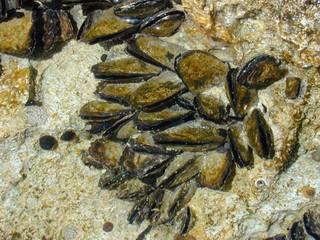 Valves compressed, rhomboidal, smooth with concentric lamellae (thin plates); color dark purple-brown. { To 41 mm. In dense beds at tide line in brackish water or on marine shore influenced by freshwater. Toothed pearl shell Valves compressed, rhomboidal, smooth with concentric lamellae (thin plates); color dark purple-brown. { To 41 mm. In dense beds at tide line in brackish water or on marine shore influenced by freshwater. Toothed pearl shell
~ Family ISOGNOMONIDAE
Isognomon californicum (Conrad)
|
|
|
|
|
~~~~~~~~~~~~~~~~~~~~~~~~~~~~~
|
|
37a |
(35) |
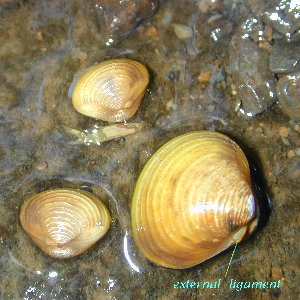 Ligament (leathery connection at hinge) external. Shell white and ribbed, mostly covered by a thin black to yellow-brown, organic layer (periostracum). To 5 cm. Freshwater streams and estuaries. Asiatic flume clam
~ Family CORBICULIDAE Corbicula fluminea Muller
|
|
|
37b |
|
Size and color variable, but with internal ligament and without a dark periostracum
|
[Note B] |
|
|
|
~~~~~~~~~~~~~~~~~~~~~~~~~~~~~
|
|
38a |
(34) |
Valves somewhat irregular, roughly oval, symmetrical; hinge short and muscle scar white. { Native, marine oysters
Ostrea spp.
|
[Note B]
|
|
38b |
|
Valves irregular, elongate, asymmetrical, with attached valve larger; muscle scar colored and eccentric (produced to one side). { Estuarine, in bays and harbors. Introduced oysters
Crassostrea spp.
|
|
|
|
|
Japanese oyster -- C. gigas
North American bluepoint -- C. virginica
|